

Tecta B20I Cantilever Chair: a Bauhaus-era idea, refined into the Kragstuhl line
A modern classic that stays technical
The B20I is Tecta’s take on the cantilever chair—an object defined less by upholstery or finish than by what its frame is willing to do. In the Kragstuhl tradition, the silhouette reads as spare, but the experience is about controlled give. It’s the sort of chair that looks quiet in a room, yet signals a very specific design lineage.

Tecta and the culture of continuations
Founded in 1956, Tecta has built its identity around Bauhaus re-editions and their thoughtful afterlives—kept in production through in-house craft and engineering. The brand’s own narrative is inseparable from the museum-and-workshop ecosystem in Lauenförde, including the Kragstuhlmuseum and a long-running commitment to Bauhaus discourse (family business; manufacturer profile).
Background: from first cantilevers to Tecta’s “tube aplati”
The cantilever chair begins with radical economy: Mart Stam’s early experiments in 1926 helped define the type (historical record). Tecta frames the B20 family as a continuation of that 1920s idea, developed with the period’s key protagonists and then stabilized through its own engineering (B20). In the broader Kragstuhl program, Tecta also documents the “tube aplati” approach—flattening sections of tube to strengthen critical points—connected to Jean Prouvé’s construction thinking and formalized through patents in the late 1980s (tube aplati).
What you feel in use
In a room, the B20I reads as a linear drawing: a continuous loop that replaces rear legs with elastic logic. That structural clarity is why it works in social settings—tables, meeting rooms, and café-like layouts—where chairs are seen in groups and from oblique angles. For reference, see the Product page.
An installation story
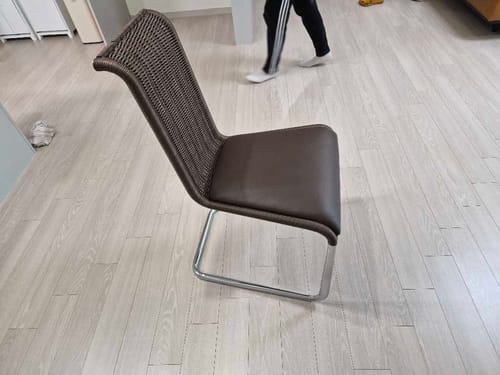
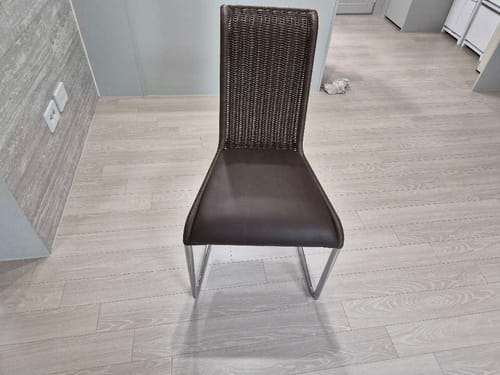
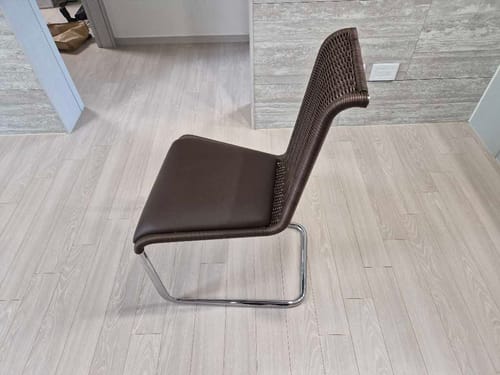
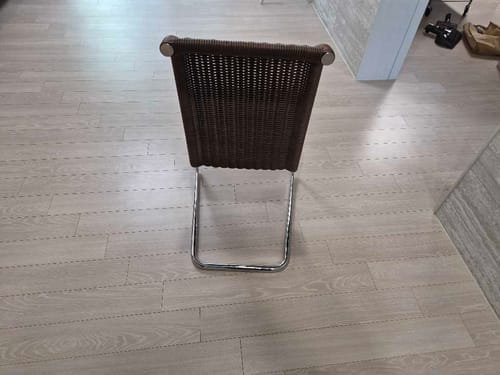
A customer notes delivery on January 5, 2026, selecting a chrome frame with brown Leather I upholstery—an understated combination that emphasizes the chair’s line first and material second. The setup reads as straightforward: the “installation” is essentially placing the chair and letting the cantilever geometry do the work.
Where it fits best
This is a chair for interiors that prefer legibility: clean sightlines, honest materials, and furniture that reads as structure. It pairs well with rectangular tables, mixed-use dining/work zones, and spaces that need seating to be visually light without becoming decorative. If the room already has chrome, steel, or other architectural metals, the B20I’s frame helps those elements feel intentional rather than incidental.
#Tecta #B20I #CantileverChair #Kragstuhl #BauhausDesign #ModernistFurniture #GermanDesign #TubularSteel #DiningChairs #ContractInteriors #DesignHistory #FurnitureDesign #InteriorArchitecture #WeavingAndSteel #MuseumOfDesign