

Magis Déjà-vu Framed Rectangular Mirror: Naoto Fukasawa’s Quietly Engineered Frame
A mirror that reads like a frame first
Magis’ Déjà-vu rectangular mirror is less about ornament and more about how a reflective plane is held, edged, and placed in a room. The result feels architectural: a crisp border that clarifies the wall around it, rather than competing with it. It’s the kind of object that looks “obvious” only after you notice how carefully it’s built.

Magis, and the value of industrial clarity
Since its start in 1976 under Eugenio Perazza, Magis has positioned itself as a design laboratory—comfortable with experimentation, but grounded in industrial repeatability and good detailing (Magis history). For this piece, that mindset shows up as restraint: a clean perimeter, precise corners, and a finish that’s meant to be lived with, not fussed over.

Naoto Fukasawa’s “normal” made intentional
Magis attributes Déjà-vu mirrors to Naoto Fukasawa and dates them to 2011 (Magis product page). Fukasawa’s broader practice is often framed through “Super Normal,” a concept he developed with Jasper Morrison (Super Normal exhibition; Design Museum Japan profile). Here, familiarity is the point: a mirror that doesn’t perform a style, it simply resolves the edges.

Details that shape the experience
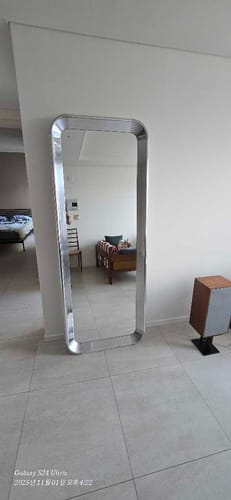
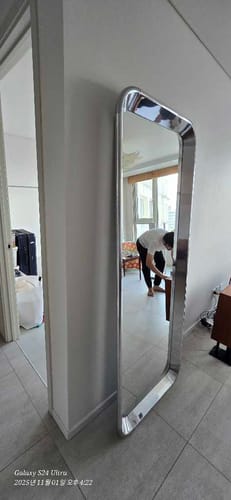
The frame is an aluminium extrusion joined with crisp cast junctions, so the perimeter reads as one continuous outline rather than four separate sides. The mirror is treated with a protective back film, and the system is designed to support either wall-hanging or a floor-leaning placement—two behaviors, one language (Materials and fixing system). For the full listing context, see the Product page.
An installation story
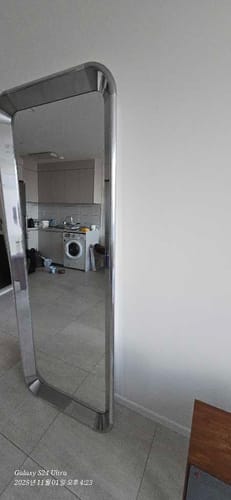
A customer review notes the mirror was delivered on November 1, 2025, and installed as a clean, tall rectangle that immediately reads as part of the room’s structure rather than added decor. The photos show the frame’s reflective perimeter holding its line even in everyday, lived-in lighting.
Where it fits best
This is a strong match for entryways, dressing areas, and circulation spaces where you want reflection without visual noise. It also works in commercial interiors that need a durable, legible object that won’t date quickly. Pair it with calm materials—painted plaster, timber, brushed metal—and it will read as part of the architecture, not an accessory.
#Magis #DejaVuMirror #NaotoFukasawa #ItalianDesign #ModernMirror #MinimalInteriors #IndustrialDesign #AluminiumFrame #WallMirror #FloorMirror #EntrywayDesign #BedroomDressingArea #ContractInteriors #DesignClassics #ContemporaryFurniture #SuperNormal