

Kartell Masters Armchair: Starck & Quitllet’s layered homage in modern plastic
A familiar chair, deliberately re-drawn
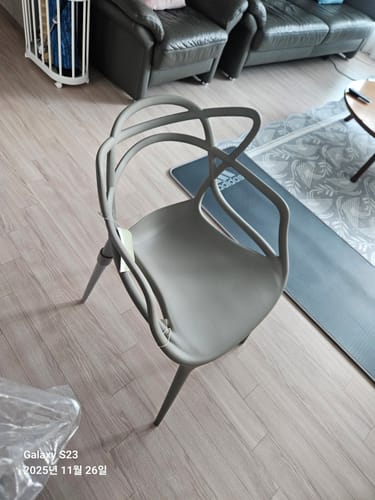
Kartell’s Masters Armchair reads as a simple dining chair at first glance—until the back becomes the story. Instead of a single shell, the silhouette is built from intersecting lines that reveal themselves as you move around it. The result is a chair that feels “graphic” more than sculptural, and intentionally referential rather than anonymous.

Kartell’s plastic culture, refined over decades
Kartell has long treated polymer as a design medium, not a compromise—pairing industrial repeatability with recognizable authorship. Masters fits that lineage: a mass-ready chair that still carries an idea. On Kartell’s own product notes, it’s positioned as a tribute chair that also works outdoors, keeping the brand’s contract-and-home crossover in view.

Where the “Masters” name comes from
Designed by Philippe Starck with Eugeni Quitllet, Masters deliberately weaves together the outlines of three modern classics—Arne Jacobsen’s Series 7, Eero Saarinen’s Tulip Armchair, and the Eames Eiffel/DSR-type profile—into a single back-and-arm graphic. Kartell describes this as an explicit homage, and Red Dot’s archive echoes the same premise in its award record. For more context, see the Product page.

Design points you notice in daily use
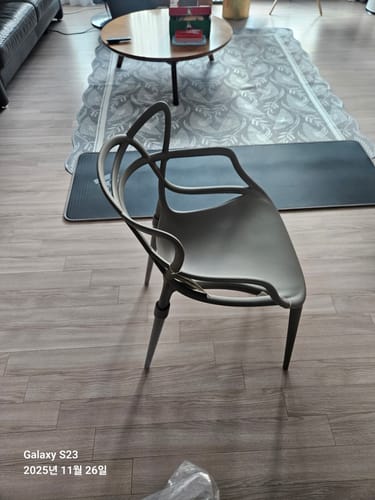
The chair’s experience is shaped by negative space: the back looks substantial but stays visually light, which helps it sit comfortably in tighter dining layouts. That layered outline also makes the chair readable from a distance—useful in cafes and larger tables where identical chairs can otherwise blur together. Masters is also commonly described as stackable and indoor/outdoor-capable, reinforcing its role as a practical “icon” rather than a fragile statement piece.
An installation story in grey
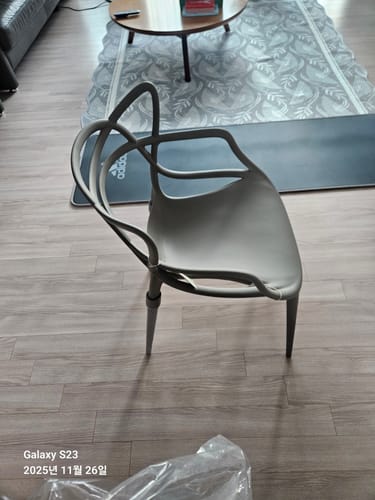
A recent buyer reports delivery completion on November 26, 2025, choosing the chair in GREY. The installation reads as straightforward—more about confirming the color in the room than learning a complicated assembly. In photos, the finish holds its own against everyday light, letting the interlaced backrest do the visual work.
Where it fits best
Masters suits spaces that like their references visible: contemporary dining rooms that mix eras, studios that lean modern but not minimal, and hospitality settings that need recognizable design without preciousness. Its strongest pairing is with simpler tables and quieter materials—wood, stone, or solid-color laminate—so the backrest linework remains legible. For collectors, it’s also a useful “conversation chair”: not rare, but intentionally loaded with design history.
References: Kartell product notes, Red Dot record, Quitllet archive, Starck studio note.
#Kartell #MastersChair #MastersArmchair #PhilippeStarck #EugeniQuitllet #ItalianDesign #ModernFurniture #DesignHistory #DiningChairs #ContractDesign #IndoorOutdoor #PlasticDesign #ContemporaryInteriors #StackableChair #RedDotAward